How to Declutter Your Home in 30 Days – A Step-by-Step Guide

Your brain never stops working. Even when you sit down to relax, it quietly scans the room. The laundry pile in the corner.
The pile of unopened mail. The junk drawer you’ve avoided for three years. Each one registers as an unfinished task.
This is the Zeigarnik Effect — a real psychological phenomenon where your brain fixates on incomplete tasks and refuses to let them go.
In a cluttered home, that mental loop runs constantly. You feel tired before your day even starts.
If you’ve been wondering how to declutter your home in 30 days without burning out, this is your plan.
It uses home organization tips 2026 readers are actually using — small daily zones, no overwhelming weekend marathons.
Week 1: High-Impact Zones and Sensorial Minimalism
Here’s the truth: most people start by attacking everything at once. They pull bags out of closets, pile clothes on beds, and drag boxes from the garage.
By Sunday afternoon, the house looks worse than Friday. That’s not failure. That’s just the wrong system.
Week one focuses on Days 1 through 7: your entryway, living room, and every flat surface in between.
These are the spaces you see most. Clearing them first creates what designers call visual quiet — that instant sense of calm when you walk through the door.
Research backs this up. Cluttered environments raise the stress hormone cortisol by 18 to 25% compared to organized spaces.
Your nervous system reads visual chaos as threat. Fixing these rooms fast is not about aesthetics. It’s about your mental state.
For 2026, the design trend worth following is Sensorial Minimalism. The goal is not a bare, cold room.
Think warm and curated. Earthy neutrals. Wood accents. A few meaningful objects instead of dozens of forgettable ones. Less visual noise. More breathing room.
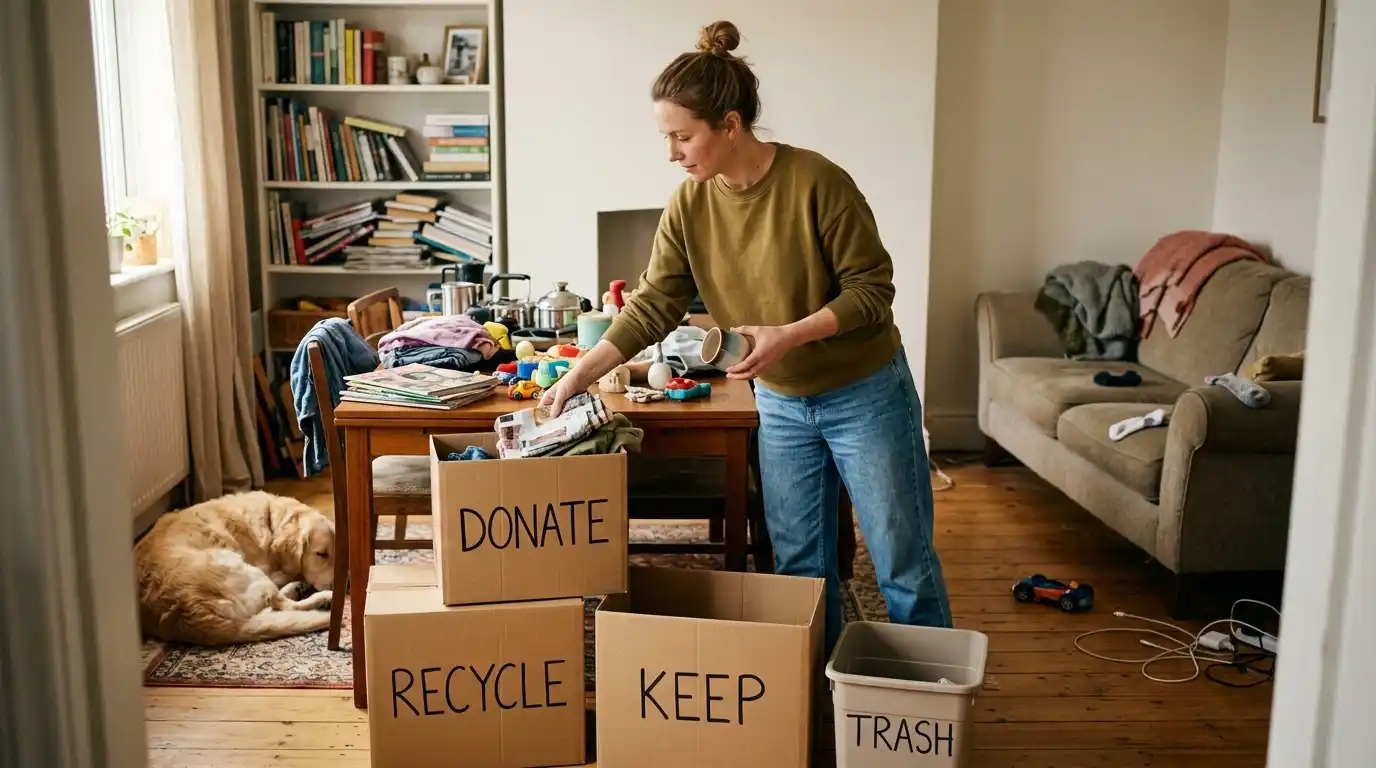
To sort everything, use the 3-Bin Method:
- Keep: Items you actively use and genuinely love
- Donate: Items in good condition — Goodwill, Freecycle, or Habitat for Humanity ReStore
- Trash: Broken, expired, or things nobody would want
The 3-Bin Method
Work through one surface per day. The entryway catch-all tray. The coffee table. The console by the couch. Don’t try to do the whole room. Just one surface.
Have a drawer full of dead batteries, rubber bands, and three sets of keys you don’t recognize? That drawer is Day 3. It takes 10 minutes.
Quick Win: Right now, grab a box and pull five things from your living room that don’t belong there. Put them where they actually go. That’s it. Done.
Your home doesn’t need to be perfect. It just needs to stop fighting you every time you walk in.
Week 2: The Kitchen and Dining Sanctuaries
We all have that one Tupperware cabinet. You know the one.
You open it slowly, hold it shut with one hand while grabbing what you need, and close it fast before anything escapes. It’s fine. We’ve all been there.
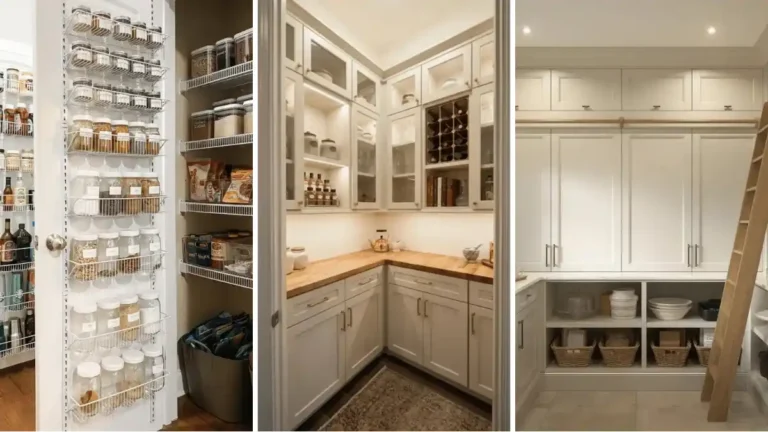
Days 8 through 14 fix that. This week covers the pantry, the fridge, the Tupperware graveyard, and the dining area.
Research shows 55% of Americans say home clutter causes them stress — and kitchens are ground zero.
The kitchen collects everything: mail, school papers, mystery appliances, and enough mismatched containers to stock a small restaurant.
Here is your purge list for the kitchen:
Kitchen Purge Hit-List
- ✅ Spices with expiration dates before 2025
- ✅ Tupperware missing lids or containers
- ✅ Single-use plastics you meant to recycle
- ✅ Appliances untouched in over a year
- ✅ Duplicate utensils (you don’t need four spatulas!)
For replacements, shift to uniform glass or bamboo containers. This is a home organization tip 2026 readers are embracing across the board.
When everything matches, your brain stops working so hard to process the visual clutter. It’s a small change that makes a big difference.
For the dining room, try what interior designers call Bookshelf Wealth — every item on display is there with intention. A small stack of meaningful cookbooks.
Two or three pieces of dishware you actually love. Nothing on the dining table except what belongs there.
The dining room should not be a landing zone for mail, bags, and unopened packages.
Quick Win: Open your Tupperware cabinet. Grab every lid that has no matching container. Throw them away. Right now. Do not hold onto them.
Week 3: Bedrooms, Bathrooms, and Wardrobe Intelligence
Days 15 through 21 get personal. This is where the real resistance tends to show up.
The bedroom should be the calmest room in your home. When it’s not, your sleep suffers. Visual clutter keeps the brain’s HPA axis — the system that controls your stress response — in a low-level alert state even when you’re lying down.
A clear nightstand and an uncluttered floor genuinely help you sleep better. That’s not just advice. That’s neuroscience.
Start with the nightstand. If it has more than three items on it, clear it down to the essentials. A lamp. A book. Water. Done.
Move to the bathroom cabinets next. Toss:
- Expired skincare and makeup (check the little jar symbol with a number — that’s the months-open limit)
- Hotel toiletries you brought home two years ago and have not touched
- Half-empty products you stopped using
- Duplicate items you bought before finding the old one
For the closet, the approach this week is Wardrobe Intelligence. This is not a capsule wardrobe sermon. It’s simpler than that. Remove anything that doesn’t fit your current body.
Wardrobe Intelligence
What Goes 🚫
• Doesn’t fit your current body
• Scratches, pinches, or feels “off”
• Free promotional t-shirts
• Single earrings & stray socks
What Stays ✨
• Clothes you actively wear
• Items that make you feel confident
• Current season items (pack away the rest!)
Remove anything that scratches, pinches, or just makes you feel off when you wear it.
Remove promotional t-shirts you would never actually buy. Remove single earrings, socks without mates, and belts from a different era.
What stays? Clothes you wear. Clothes you feel good in. That’s the whole system.
Pack seasonal items into labeled bins and store them. Your daily closet should only hold what’s in season.
Quick Win: Check your makeup bag or bathroom cabinet right now for anything expired. If there’s a product you’ve had open for over a year, throw it away today.
A bedroom that works for sleep is the best investment in your home you can make. Clear the surfaces. The rest follows.
Week 4: Deep Storage and Digital Decluttering
Now that your living spaces are breathing, it’s time for Days 22 through 28: the home office, the garage, and your digital life.
Dr. Joseph Ferrari, a psychology professor and researcher who has spent decades studying procrastination, found that holding onto objects out of guilt or “someday” promises directly fuels decision fatigue.
Psychology Fact: Decision Fatigue
Every time you walk past that guitar you were definitely going to learn, your brain registers an incomplete task. Letting go of guilt-driven “someday” items instantly reduces low-grade mental exhaustion!
Every time you walk past the rowing machine you bought in 2021 or the guitar you were definitely going to learn, your brain registers another incomplete task. That’s another quiet drain on your energy.
The garage rule is straightforward. If you have not used something in two years, and the honest answer to “will I really use this?” is no — it goes.
Donate the camping gear you’ve taken out once. Sell the tools for projects you’ve already hired out. Let go of the hobbies that belonged to a different version of you.
For the home office:
- Set up a simple paperless filing system using folders in Google Drive or a scanner app
- Shred anything you’ve scanned and anything older than seven years (check your specific tax document requirements)
- Cancel subscriptions you forgot about — go through your bank statement line by line
Don’t overlook your digital clutter. Unsubscribe from email lists that have been filling your inbox for years. Delete photo bursts — those 14 nearly identical shots you took of the same thing. A clean inbox and a manageable photo library reduce low-grade mental noise more than most people expect.
The goal is not just a cleaner house. It’s fewer open loops. Every item you clear closes a tab your brain has been quietly keeping open. That’s how how to declutter your home in 30 days works at a psychological level — not just a physical one.
Quick Win: Open your email inbox and unsubscribe from five newsletters right now. Not later. Now.
Days 29 and 30: Building Systems That Actually Last
The cleanout is done. Now the work is keeping it.
Most people skip this part. They do a big declutter, feel great for two weeks, and then slide back into the same patterns.
The fix is not more willpower. It’s building small, automatic systems.
The 5-Minute Nightly Reset
Each night before bed, spend five minutes returning things to their homes. Shoes by the door. Dishes in the sink or dishwasher.
Surfaces clear. That’s it. Five minutes prevents the slow drift that builds back into chaos.
And checking off a daily task list — even a short one — triggers a small serotonin release. Your brain rewards follow-through.
The One-In, One-Out Rule
Every new item that comes into the house requires one item to leave. New shoes? Donate an old pair before they go in the closet.
New kitchen gadget? One old one goes. This rule alone prevents re-accumulation.
The Donation Bin in the Car
Keep a reusable bag or small box in your trunk. When something is ready to donate, it goes in the car.
Not in a pile by the door. Not back on a shelf “for later.” In the car. When the bin fills up, drop it at Goodwill or Habitat for Humanity ReStore on your next errand.
Track your daily progress with a simple Excel or Google Sheets checklist. Visually seeing the boxes fill in keeps momentum going.
Quick Win: Put a small bin or bag in your trunk today. Label it “Donate.” That bin will do more work for you than any organizing tip you’ve ever read.
Wrapping Up Your 30-Day Declutter Challenge
Reclaiming your home doesn’t require a magical free weekend. It requires small, consistent, daily decisions. One zone at a time. One bin at a time. One drawer at a time.
You’ve spent 30 days moving through the entryway, the kitchen, the bedroom, the bathroom, the garage, and even your inbox.
Each cleared surface is one fewer open loop for your brain to manage. That’s not just an organized home. That’s actual mental relief.
Ready to get started? Download our free Excel Decluttering Tracker to check off your progress every single day.
Learning how to declutter your home in 30 days is just the beginning of living a more intentional, peaceful life. The spaces you cleared this month will only get easier to maintain from here.