12 Adinkra Symbol Decor Ideas With Real Meaning Behind Them


Most decor articles hand you a symbol and a stock photo caption, and call it done. That skips the part that actually matters: what the mark meant to the people who carried it first.
Adinkra symbols come from the Akan people of Ghana, originally stamped onto cloth for funerals, court ceremonies, and everyday wear long before anyone thought of them as wall art.
Each one carries a specific idea about how to live. That history is worth more than a passing mention.
These Adinkra symbol decor ideas are built around that meaning first, then the placement.
You will find where each symbol sits comfortably in a home, what to pair it with, and what to avoid so it does not read as random pattern. Some of these are quiet, single-piece choices. Others anchor a whole room.
Twelve symbols, twelve real ideas, and a little context you can actually explain to a guest who asks about the piece on your wall.
12 Adinkra Symbol Decor Ideas With Real Meaning Behind Them
1. Sankofa Belongs Where You Actually Pause

Sankofa is the bird with its head turned backward and its feet facing forward, and it means going back to reclaim what was left behind before moving on.
It is one of the most recognized Adinkra symbols, and also one of the most misplaced, since people tend to hang it wherever there is empty wall space rather than where its meaning actually fits.
The idea behind Sankofa is reflection, so it rewards a spot where someone naturally slows down for a moment, not a hallway they walk through without thinking.
A rushed transition space undersells a symbol built around pausing to look back. This is also a symbol that works better small than large.
A oversized Sankofa piece can start to feel like a statement about the whole house, when really its meaning is more personal, closer to a private reminder than a public announcement.
Keeping it modest in size keeps that intimacy intact. Three placements do this well, and each one gives the symbol a reason to be exactly where it sits.
2. Gye Nyame Needs Room to Breathe

This symbol gets crowded more than any other one on this list, and it loses something real every time that happens.
Gye Nyame translates roughly to “except for God,” and it stands as the most reproduced Adinkra symbol for a reason that goes beyond how it looks.
It carries serious weight in Akan tradition, tied to the idea that nothing exists or happens outside a higher power.
Hanging it beside a cluster of unrelated wall art, souvenir magnets, or seasonal decor flattens that meaning into background noise, and it starts to read as pattern rather than statement.
People often make this mistake with good intentions, treating Gye Nyame as a centerpiece that should be surrounded by supporting pieces, the way you might build a gallery wall around a family photo.
But this symbol was never meant to share a frame group. It carries enough on its own that anything placed too close ends up competing rather than complementing.
💡 Quick Tip
Give Gye Nyame its own wall space, at least two feet of clearance on each side, before you add anything else nearby.
3. Adinkrahene Sets the Tone at the Front

Adinkrahene is built from concentric circles, and it means “chief of the symbols,” standing for leadership, greatness, and the kind of quiet authority that does not need to announce itself.
Of everything on this list, it is the one most tied to a specific role, which makes its placement matter more than usual.
It works best as the piece that greets people first, since that placement is close to its original function marking the seat of leadership.
A front door, an entry table, or the first wall someone sees walking in all give the symbol a job to do rather than treating it as filler decor.
There is also a practical reason this symbol suits entry spaces so well. The concentric circle design reads clearly even from a distance or at a glance, unlike more detailed symbols that need close viewing to register.
That makes it one of the few Adinkra designs that actually works as a first impression rather than something discovered later.
4. Dwennimmen Anchors a Shared Reading Corner

The ram’s horns, curved outward but locked together at the base, stand for humility paired with strength.
It is a symbol about restraint rather than passivity, the idea that real power knows when to yield, and that pairing makes it a natural fit for a shared space where two people sit and actually talk to each other.
Most people try to force this symbol onto a single piece, which misses the point entirely, since the design is built around a pair.
A lone ram’s horn loses half its meaning, because the whole idea depends on two forces locking together rather than standing alone.
This is one of the easier symbols to work into a space gradually, since it does not require a single expensive centerpiece.
Building it out over a few small purchases actually suits the symbol better than one big statement item, since patience is part of what it represents.
Select a Matching Pair
Pick two matching cushions instead of one, since the symbol itself is a pair, not a single shape.
Align Stencils Inward
Stamp or stencil the symbol facing inward on each cushion, so the pair reads as one connected design when placed side by side.
Place on Wide Seating
Set them on a bench or window seat rather than a single armchair, so the pairing actually has room to sit as a pair.
5. Akoma Deserves Fabric, Not Just Frames

People default to printing Akoma, the heart symbol for patience and love, on canvas and hanging it like every other piece of wall art.
That is not wrong exactly, but it undersells a symbol whose whole meaning is about ongoing, hands-on care, something closer to textile than to a fixed image behind glass.
The distinction matters more than it sounds like it should, since a symbol about patience that never gets touched starts to feel decorative instead of lived in.
Meaning tends to fade from objects that just sit there, and Akoma in particular loses something when it becomes purely visual rather than something a hand passes over. There is also a practical upside to choosing fabric over canvas here.
Textile pieces are easier to rotate seasonally, easier to wash, and easier to replace without much cost if the design starts to wear, which actually keeps the symbol in more regular use rather than becoming a fixed, untouched fixture.
Work Akoma into a throw pillow, table runner, or woven blanket that actually gets handled and washed.
Let it live somewhere touched daily, like a couch or a bed.
Do not seal it behind glass in a formal room no one actually sits in.
Do not pair it with symbols carrying unrelated meanings just to fill leftover wall space.
6. Nyame Dua Works Best as a Living Centerpiece

Nyame Dua, the altar symbol tied to the idea of God’s presence and protection, was traditionally placed outside homes as a small shrine, often with a bowl of water set at its base.
That origin matters here, because it points toward decor that involves something living or changing, not a static piece bolted to a wall.
A plant stand built around this symbol carries that spirit forward in a way a flat print cannot.
The symbol works into the base or the pot itself, while the plant above it does the part that a carved altar once did outdoors, standing as something tended to regularly rather than looked at once and forgotten.
This is also one of the few symbols on this list where placement genuinely has two strong options, depending on how much presence you want it to have in the room.
| Corner Placement | Windowsill Placement |
|---|---|
| Anchors a quiet reading nook or seating corner. | Ties the symbol to natural light through the day. |
| Works well with a taller plant and low lighting. | Better for smaller pots that need daily sun. |
7. Fawohodie Is the One Statement Piece a Room Needs

Fawohodie means freedom, independence, and emancipation, and it carries more historical and emotional weight than almost any other symbol on this list.
Because of that, it does not work well split across several small objects the way some gentler symbols do.
This is a single-piece symbol. It wants one strong, well-made object, not a print duplicated across three throw pillows or scattered as a pattern on a rug border.
Treating it as a bold statement piece respects both the symbol and the history behind it far more than treating it as background texture.
A room that already feels a little unfinished, missing that one piece that pulls everything together, is often exactly where Fawohodie belongs.
It does not need supporting decor around it to make sense. It is meant to be the thing the room organizes itself around.
Fawohodie wants one strong piece and open space around it, not company from smaller decor competing for attention.
8. Nkyinkyim Rewards Some Planning Before You Commit

Nkyinkyim represents dynamism, versatility, and initiative, often shown as a zigzag or twisting pattern that suggests a life path full of change rather than a straight line.
It is a more visually complex symbol than most on this list, which means it works differently depending on where you put it.
Because the pattern reads as movement, it tends to work best somewhere the eye already travels, like a staircase wall, a hallway runner, or a curtain that catches light and shifts through the day.
Committing to this symbol in a large format is a bigger decision than something like Sankofa or Akoma, so it helps to gather a few things before buying anything final.
Getting the scale and material right up front saves a return trip later, especially since this symbol tends to show up on larger textiles and runners rather than small accent pieces.
Before you commit, gather this
9. Duafe Belongs Near Where You Actually Get Ready

Duafe, the wooden comb symbol, represents feminine care, beauty, and the qualities associated with looking after both appearance and home.
Historically it was a literal object before it became a decorative symbol, which makes its ideal placement fairly intuitive once you think about it.
A vanity nook that has been sitting bare, or a dresser top that never quite feels finished, is usually the answer.
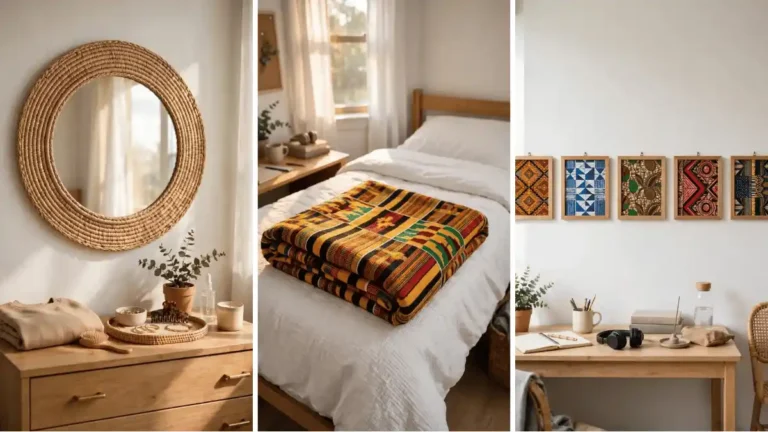
The symbol works whether it appears as an actual small carved comb propped decoratively, or as a motif worked into a mirror frame or tray used daily. What makes this one satisfying is how visible the improvement is.
A vanity corner with no personal touch reads as purely functional, while the same space with Duafe worked in starts to feel considered, like someone actually chose to be there rather than just passing through to get ready.
A dresser top with a mirror and nothing else, purely functional and easy to overlook.
A small carved Duafe comb resting against the mirror frame, turning the same corner into a space that feels chosen.
10. Aya Works Quietly, But Only in the Right Spot

Aya, the fern symbol, represents endurance, resourcefulness, and the ability to withstand hardship, drawing on the fern’s real ability to grow in difficult, shaded conditions.
It is a gentler, quieter symbol than most on this list, and that quietness is both its strength and its limitation. Placed well, Aya adds a subtle layer of meaning without demanding attention.
Placed poorly, in a busy space competing with bolder patterns or louder colors, it disappears entirely, which defeats the purpose of choosing a symbol with real meaning behind it in the first place.
📌 Good to Know
Aya works best alone or with one quiet neighbor. Next to bold patterns or bright colors, it tends to disappear entirely.
11. Bese Saka Belongs Near Where People Actually Gather

Bese Saka, the sachet of cola nuts, represents abundance, unity, and togetherness, tied historically to hospitality and the sharing of resources among a community.
That meaning points directly to where it should live in a home, which is anywhere people actually gather rather than a formal space reserved for guests who rarely visit.
A kitchen, a dining nook, or a spot near where meals get shared all make sense for this symbol, since abundance in the Akan tradition was never abstract.
It meant having enough to offer someone else, and a dining space is where that idea plays out daily, whether that is a family dinner or a quick coffee with a neighbor.
This is also a forgiving symbol to work with, since it pairs well with practical items already in that part of the house, like a woven basket, a set of coasters, or a tray used for serving.
12. Mpatapo Works Best in a Space Everyone Shares

Mpatapo, the knot symbol, stands for reconciliation and peacemaking, historically tied to settling disputes and restoring harmony between people who had fallen out.
Of every symbol on this list, this is the one most clearly meant for shared space rather than a single person’s room, since its whole meaning is about connection between people.
A family room, a shared hallway, or a space that multiple people pass through daily fits this symbol far better than a private bedroom or a home office used by one person alone.
The idea is less about individual reflection and more about the ongoing, sometimes messy work of staying connected to the people you live with.
Bringing this symbol in works well as a small, deliberate project rather than a single purchase, especially if it becomes something the household does together.
Choose a shared wall, like the one in a family room or main hallway, rather than a private space.
Pick a knot-motif textile or carved piece the whole household helped select, not something chosen alone.
Hang it at a height everyone in the home actually sees, not tucked above a doorway where it goes unnoticed.
Conclusion
Twelve symbols, and not one of them is just a pretty shape to fill a wall. Each carries a specific idea about how to live, whether that’s the patience behind Akoma, the shared abundance behind Bese Saka, or the quiet reflection behind Sankofa.
Matching the symbol to the right spot in a home, rather than scattering them at random, is what keeps that meaning intact.
Adinkra symbol decor ideas work best when the placement makes sense with the story, not just the color scheme.
A heart symbol belongs somewhere it gets touched daily. A symbol about reconciliation belongs in a room the whole family shares.
Small choices like that are what separate decor with real weight behind it from decor that just looks nice in a photo.
Save this list for whenever you’re ready to bring one of these into your own space, one symbol at a time.