
20 HBCU Dorm Room Decor Ideas That Go Beyond the Basics

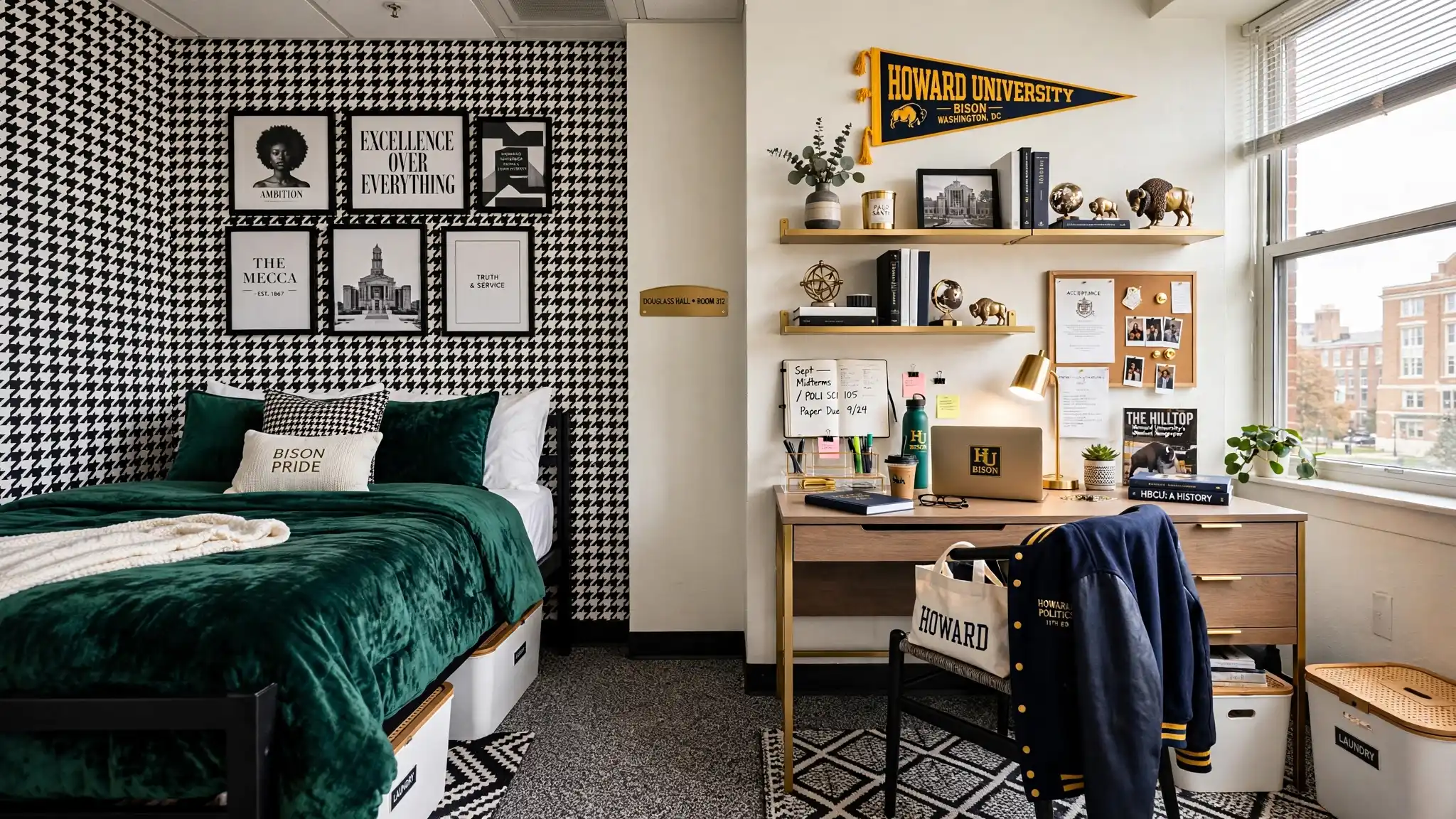
Your dorm room key turns in the lock for the first time, and the room staring back is just white walls, a metal bed frame, and a mini fridge humming in the corner. That blank box is not going to decorate itself, and a couple of string lights and a poster will not make it feel like yours either.
This list is built for anyone chasing HBCU dorm room decor ideas that actually reflect where you come from, not just whatever showed up first on a mood board.
Most decor guides hand you the same five moves. Fairy lights, a tapestry, a corkboard. None of that is wrong, but none of it says much either.
What makes a room feel grounded is texture, story, and objects that mean something, from the cloth your grandmother might recognize to the photo wall that keeps your people close while you are away from them.
The twenty ideas ahead go past the basics on purpose. Some are quick fixes you can do in an afternoon.
Others take a little more planning. All of them work in a shared, rented, temporary room.
20 HBCU Dorm Room Decor Ideas That Go Beyond the Basics
1. Turn Your Cinder Block Wall Into a Kente Cloth Gallery Moment
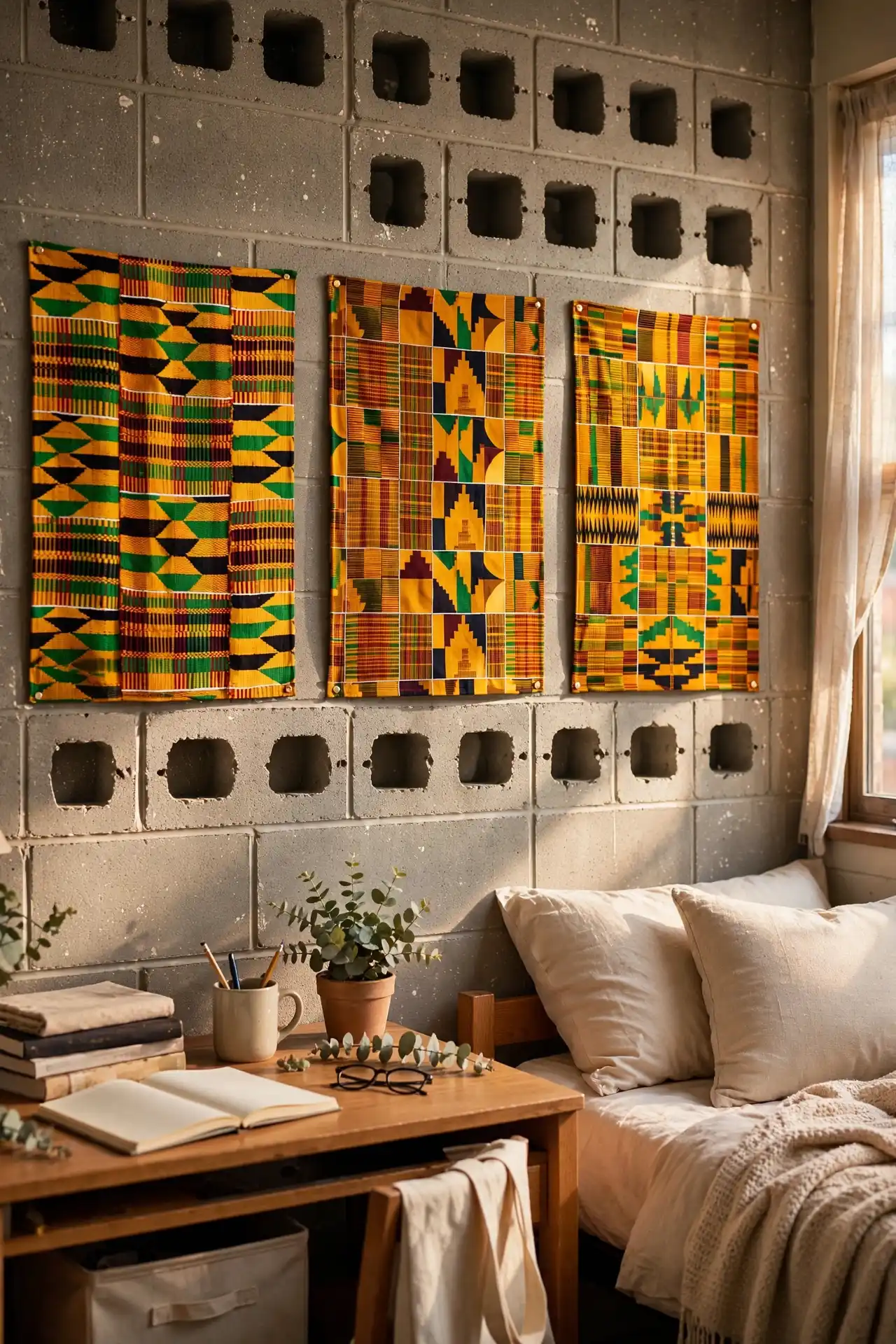
Cinder block walls do not have to stay cold and bare for two full semesters. Kente cloth solves that problem better than a single tapestry because of its bold woven stripes and rich color blocking.
Instead of covering the whole wall with one large piece, pin three or four smaller Kente panels in a loose grid pattern. This breaks up the gray block in a way that feels curated rather than just covered up.
A few placement notes before you start:
- Use removable adhesive strips along the fabric edges, not just the corners, so the panels stay flat against uneven block
- Leave a couple inches of visible block between each panel so the pattern reads as intentional spacing, not a mistake
- Pick panels in two or three colors from the same family so the whole grid feels connected instead of scattered
This setup also works well in a shared room where your roommate wants to keep their side plain, since the panels stay contained to your section of the wall.
2. Swap the Basic Throw for a Mudcloth Layering Trick
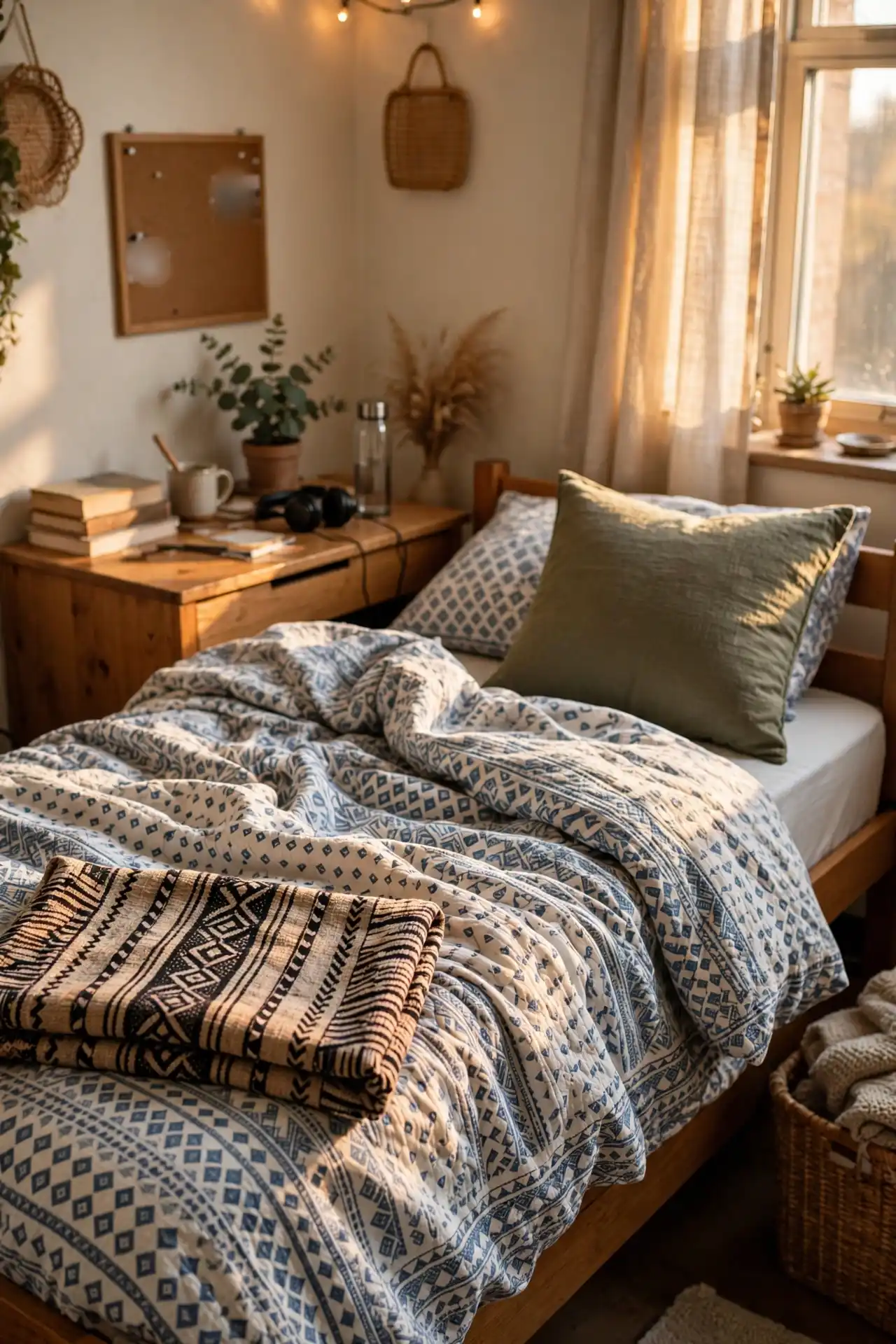
A plain throw over a plain comforter is still plain, it is just softer to the touch. Mudcloth changes that fast because of its bold geometric print and matte, textured surface that catches light differently than a smooth blanket does.
Instead of draping it flat across the bed the way most people do, fold it in thirds and lay it across the foot of the bed.
This keeps the pattern visible even on mornings when the rest of the bed is unmade and rushed.
Pair the mudcloth with one solid colored throw pillow instead of three patterned ones fighting for attention.
That single contrast point is what makes the whole layer look styled instead of cluttered.
If you want to rotate the look through the semester, keep a second mudcloth piece in a different pattern folded in your closet and swap it in when the first one starts to feel routine.
💡 Quick Tip
Fold the mudcloth in thirds instead of draping it flat. The pattern stays visible even on a messy morning.
3. Build a Legacy Corner With Family Photos and HBCU Memorabilia

A wall of photos taped up during the first week of move-in rarely survives past October.
The tape dries out, corners curl, and eventually half of them end up back in a drawer.
A legacy corner is built to last the whole year instead. Pick one shelf, one windowsill, or one section of wall and commit to it fully.
Group five to seven photos in matching frames so the eye reads them as one collection rather than scattered pieces.
Then add one object that is not a photo at all. A pressed program from a homecoming event, a small pin from a family member’s own college years, or a folded acceptance letter all work well here.
That single non-photo object is what turns the corner from a photo wall into something closer to a small archive of where you come from.
Keep the frame styles consistent, even if the sizes vary slightly, since matching frames do more visual work than matching photo colors.
Loose photos taped in random spots, edges curling by October.
One framed corner with matching frames and a keepsake object, still intact in April.
4. Cover That Sad Desk Chair in Adire Fabric

That metal desk chair every dorm room ships with is not going anywhere for the next four years, so the smarter move is working with it instead of trying to hide it under a jacket every day.
Adire fabric, known for its resist-dye technique and indigo based patterns, wraps around a standard chair seat in under an hour and needs no sewing machine at all.
Cut the fabric a few inches larger than the seat itself, wrap it around the cushion, and secure the edges underneath with fabric glue or a small staple gun borrowed from your dorm’s front desk.
Trim off anything that hangs loose so the finished edge looks clean from every angle, not just the front.
Once the chair is covered, it stops looking like something the university handed you and starts looking like a piece you chose on purpose for the room.
Cut the fabric to fit the seat, leaving a few extra inches on each side.
Wrap it around the seat and secure it underneath with fabric glue or a staple gun.
Trim the excess fabric and tuck the edges under so nothing hangs loose.
5. Create a Reading Nook With Ankara Floor Cushions
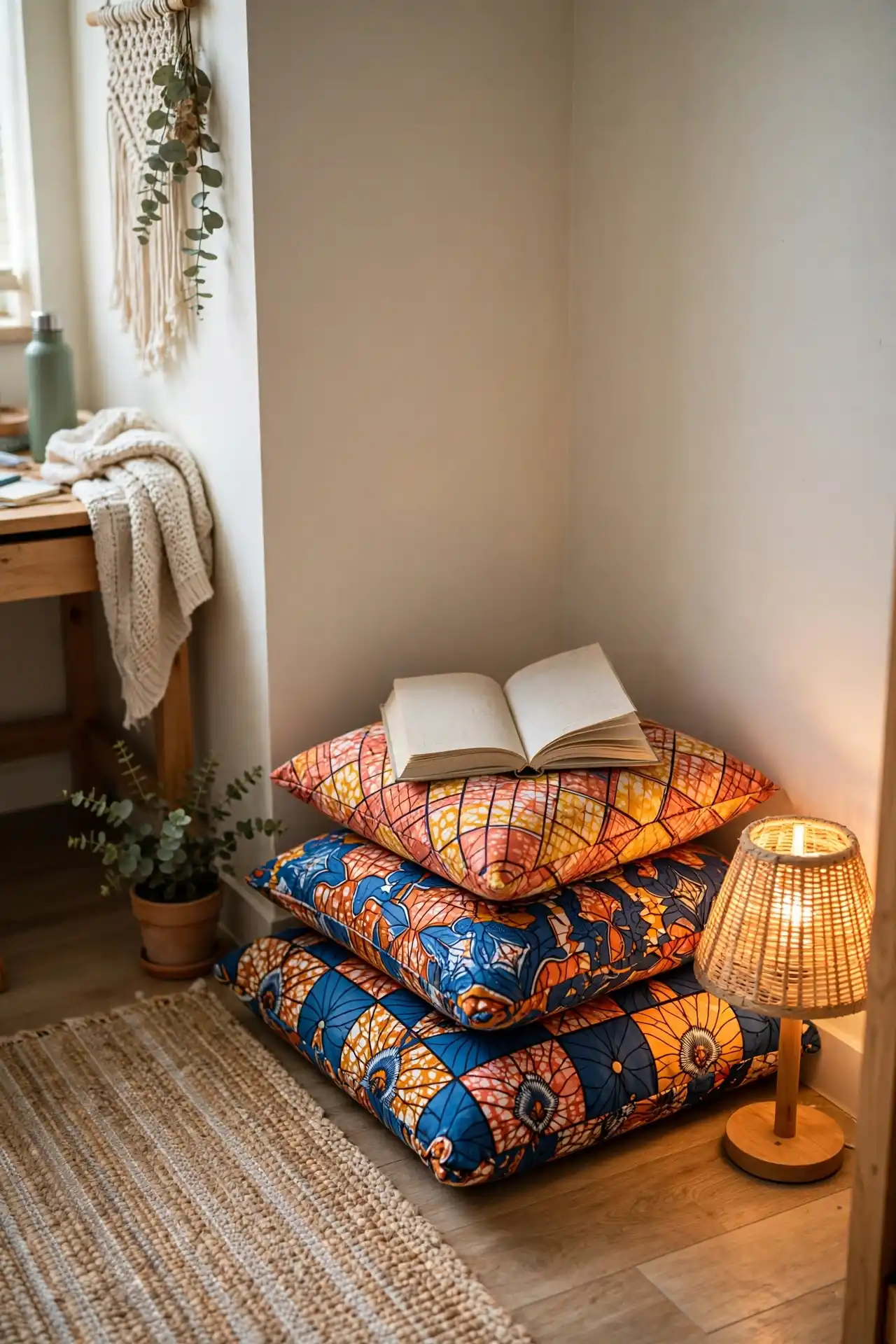
Most attempted reading nooks fail for a simple reason. People try to force a nook-shaped idea into a corner that is really just leftover floor space between the closet and the wall.
Ankara floor cushions work with that awkward shape instead of fighting it. Their bold wax print patterns hold up visually even when the cushions themselves are stacked unevenly or squeezed into a tight footprint.
Stack two or three cushions at different heights rather than laying one flat cushion down alone.
The height variation gives your body something to lean back into, which matters more than people expect when the only other seating option is a stiff desk chair.
Add a small clip-on or floor lamp nearby so the corner has its own light source instead of depending on the harsh overhead dorm lighting.
Finish the space with one low side table, even something as simple as a wooden crate, so you have somewhere to set a drink or a book down without reaching across the room.
Stack two or three cushions at different heights.
Add a small floor lamp for its own light.
One flat cushion pushed into a corner.
Relying only on the overhead light.
6. Pick a Color Story Rooted in Adinkra Symbols, Not Random Prints

Random prints thrown together usually end up looking chaotic by week three, even if each piece looked good on its own in the store.
Adinkra symbols solve this because each one carries a specific meaning, from Sankofa representing looking back to move forward, to Gye Nyame representing the supremacy of a higher power.
Picking two or three symbols that mean something to you personally gives your whole room a reason behind its colors instead of a random mix.
Once you choose your symbols, pull two or three colors directly from them and repeat those same colors across your bedding, wall art, and any small accents like a lamp shade or desk organizer.
This repetition is what separates an intentional room from one that just has a lot of stuff in it.
| Random Prints | Adinkra Symbols |
|---|---|
| Colors picked separately per item | Colors pulled from two or three symbols |
| No connection between pieces | Every piece ties back to a meaning |
| Can look busy by month two | Stays cohesive as the palette repeats |
7. String Lights Through a Raffia Fringe Curtain for Instant Warmth
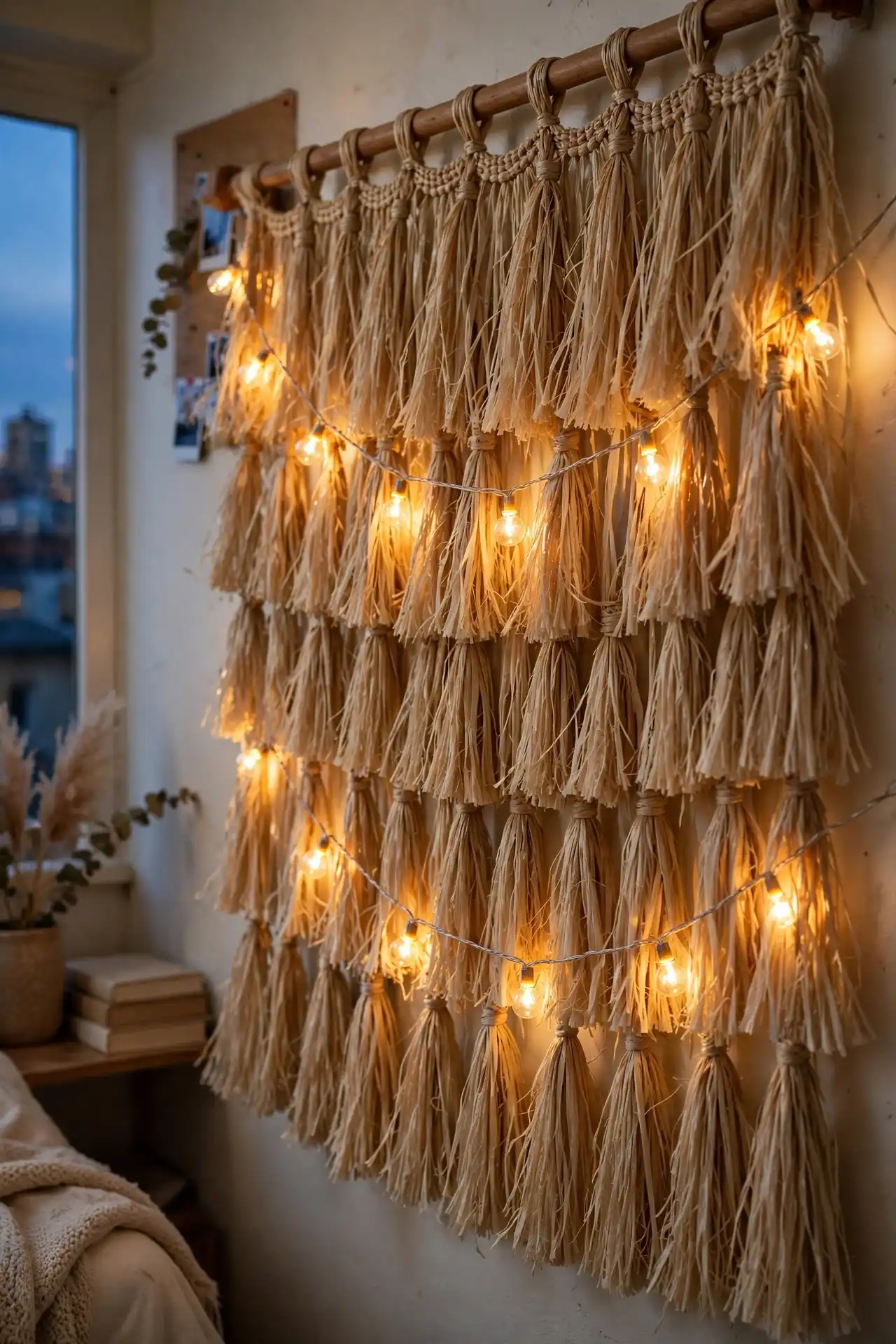
Plain string lights taped straight to the wall in a zigzag pattern have become so common they barely register anymore.
Weaving them through a raffia fringe curtain instead gives the same warm glow but with texture and movement that a flat wall of lights can’t match.
Hang the raffia panel first, then thread the light strand through the fringe in loose loops rather than pinning it flat against the strands.
The natural fiber also softens the light itself, so it casts a warmer, more diffused glow across the room instead of a sharp point of light from each bulb.
8. Turn Your Closet Door Into a Rotating Vision Board
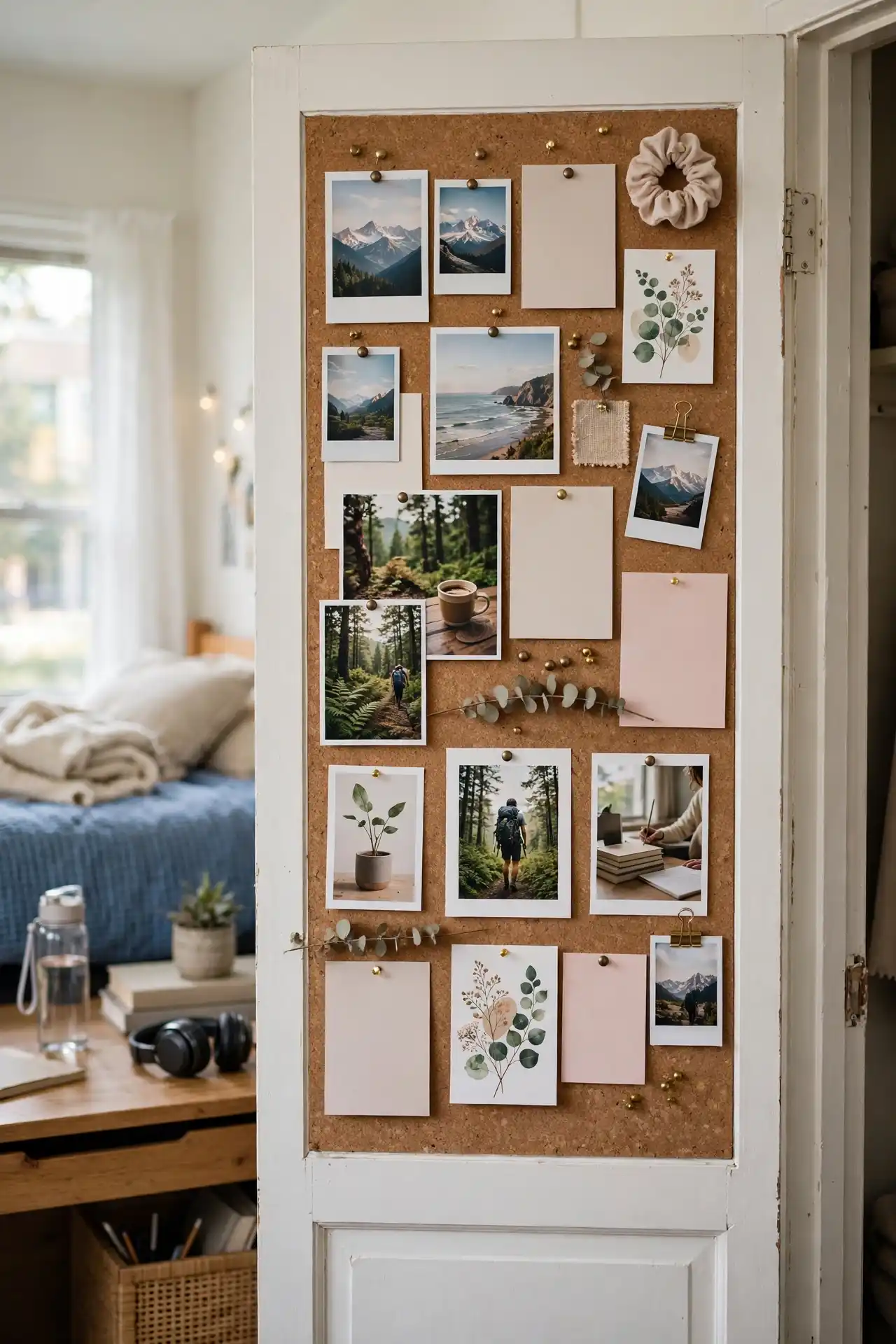
Desk space in a dorm room disappears fast, which leaves no room for the goal lists and inspiration pages most people want to keep visible.
The inside of your closet door solves this problem since it’s flat, unused, and only seen when the door is open, meaning it stays private from roommates or visitors.
Cover the inside panel with cork strips or a large sheet of cork board material, then pin up items that actually rotate through the semester instead of staying static for eight months straight.
What to pin up first:
- A current semester schedule or syllabus printout
- Two or three goals for the term, written on cards you can swap out
- A few postcards or ticket stubs from things you want to remember
What to pin up first
9. Repurpose a Woven Basket as Hidden Nightstand Storage

Dorm nightstands are usually one tiny drawer, barely enough for a phone charger and a pair of earbuds.
A woven basket set beside the bed solves the overflow problem without adding another piece of hard furniture to a room that’s already tight on floor space.
Use it to hold everything that normally ends up scattered across the desk, like extra chargers, a journal, or a stack of face masks.
The open weave also means the basket doubles as texture on its own, so it works as decor even before anything is placed inside it.
A woven basket beside the bed replaces a missing drawer and adds texture at the same time.
10. Layer Your Bed in Bogolanfini Instead of a Plain Comforter
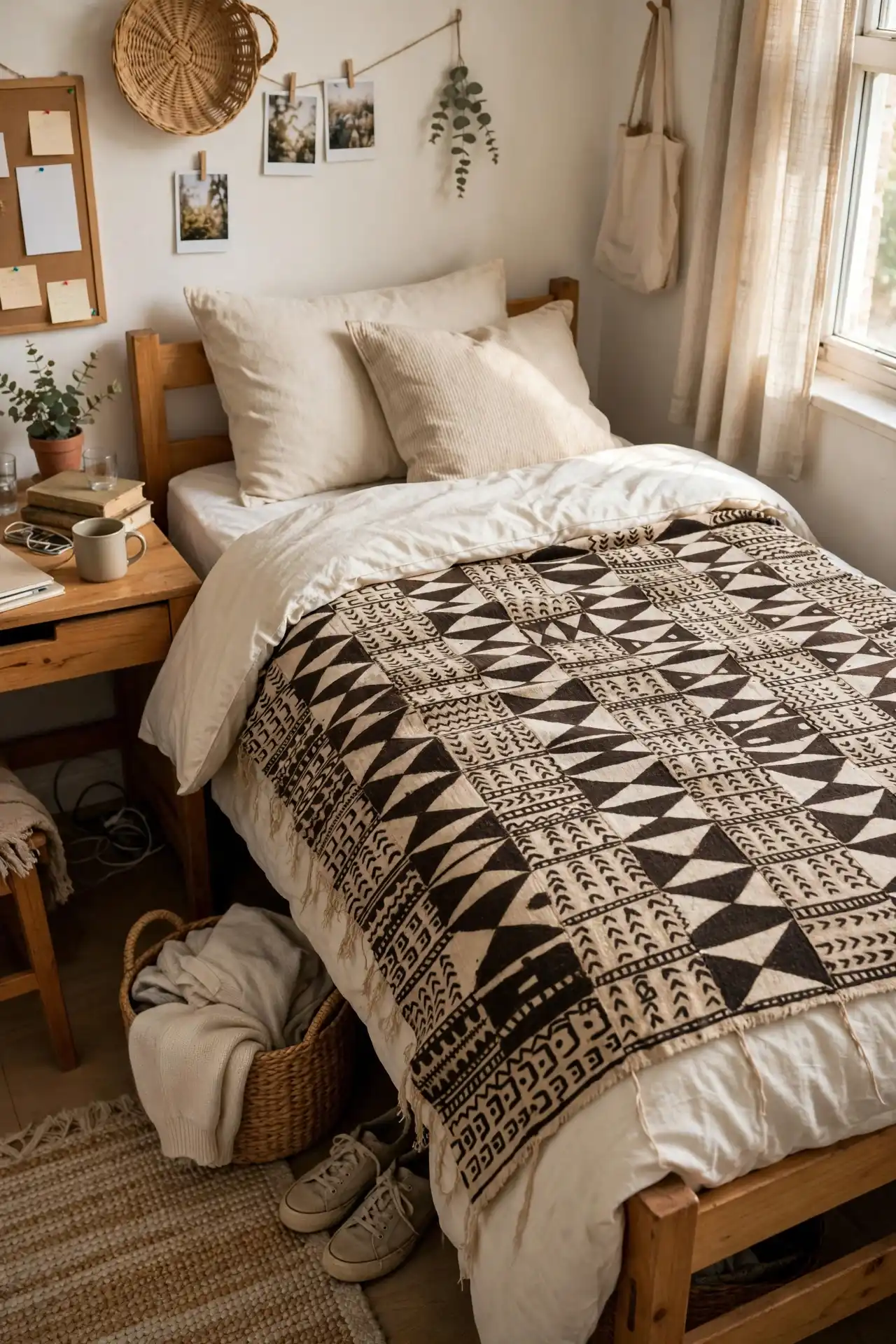
The standard dorm comforter that came in your move-in bundle works fine as a base layer, but it rarely looks finished on its own.
Bogolanfini, the traditional Malian mudcloth made with fermented mud dye, adds a layer of history and texture that a solid color comforter can’t offer by itself.
Use it as a top layer folded across the lower half of the bed rather than replacing the comforter entirely, since keeping the original underneath still gives you warmth on cold nights.
📌 Good To Know
Layer the Bogolanfini over your existing comforter instead of replacing it, so you keep the warmth underneath.
11. Style Your Desk Shelf With Brass Accents and Shea Butter Jars

Bare desk shelves in a dorm tend to fill up fast with textbooks and random clutter, leaving no room for anything that actually looks good.
A small brass tray placed at one end of the shelf gives you a defined spot to group items instead of letting them spread across the whole surface.
Fill it with a few empty or refillable shea butter jars, since their round shape and cream color contrast nicely against the metal.
Keep the grouping small, three or four pieces at most, so the shelf still has breathing room around the books.
12. Choose Between a Tapestry or a Fabric Panel for Your Headboard Wall

Not every wall behind the bed needs the same treatment, and this is one of the few spots where the two most common options actually work best for different situations.
A tapestry hangs loose and covers more square footage at once, which suits a bare wall with nothing else on it.
A structured fabric panel, mounted flat on a frame, holds its shape better and works when you already have shelves or hooks competing for space nearby.
Think about how much wall you’re actually covering before picking one over the other.
| Tapestry | Fabric Panel |
|---|---|
| Covers more wall space at once | Better for walls with shelves nearby |
| Hangs loose, some movement | Mounted flat, holds its shape |
| Easiest for a totally bare wall | Cleaner look around existing hooks |
13. Frame Your HBCU Acceptance Letter Like Real Art
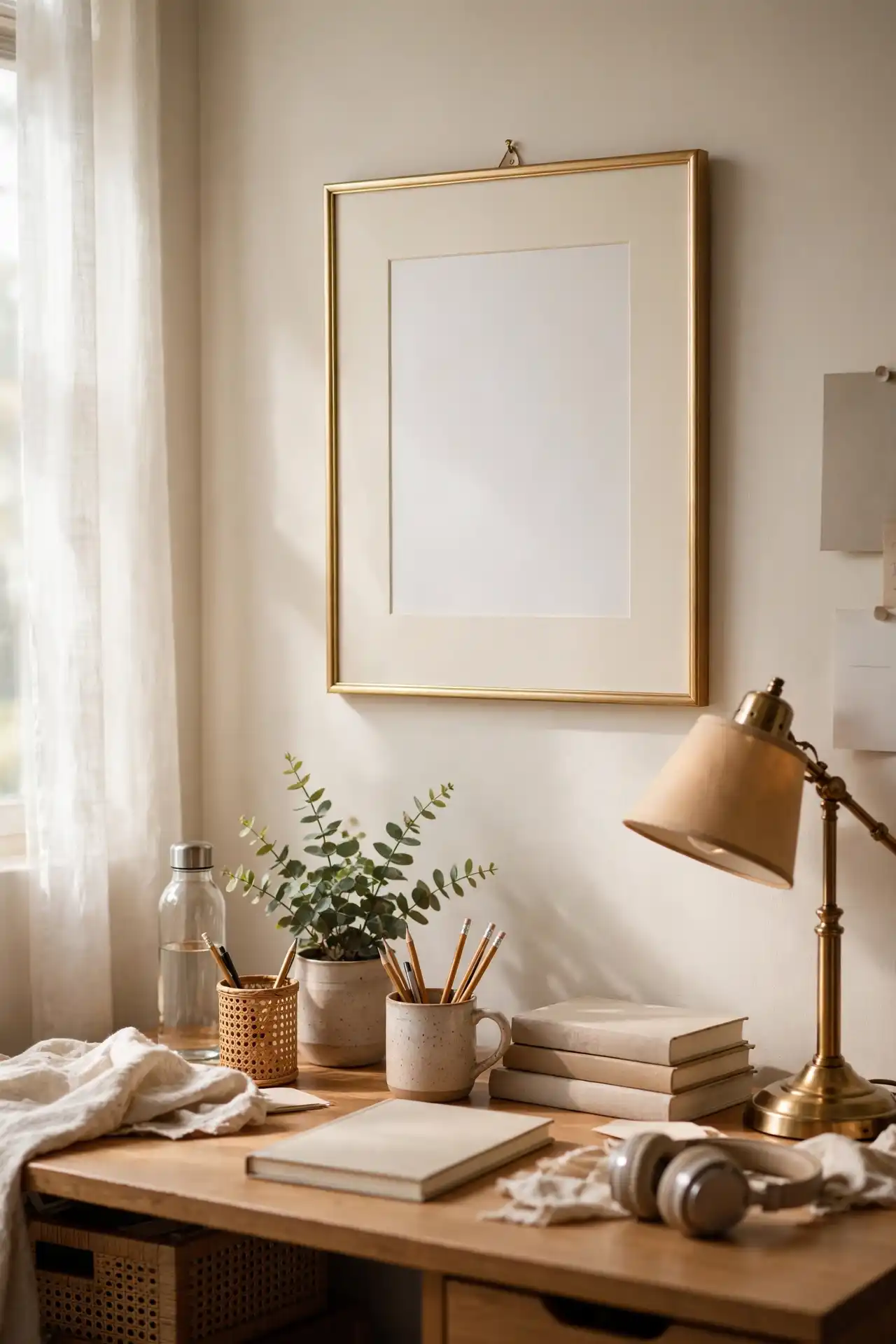
That acceptance letter usually gets folded into a drawer within the first week and forgotten until move-out.
Framing it instead turns a piece of paper most people discard into a genuine focal point.
Use a mat board around the letter rather than pressing it flush against the glass, since the extra border space makes even a plain printed letter read like a gallery piece instead of a document.
Hang it at eye level near your desk, somewhere you’ll actually look at it during a long study session, not tucked in a corner where it disappears into the wall.
Folded in a drawer, forgotten until move-out day.
Matted, framed, and hung at eye level near the desk.
14. Add a Plant Corner With African Violets in Terracotta Pots

A dorm room with zero greenery tends to feel flat no matter how much fabric or artwork you’ve added elsewhere.
African violets work particularly well in a dorm setting since they tolerate lower light and don’t need constant repotting.
Group three pots of slightly different sizes on a windowsill or shelf corner instead of spacing them evenly apart, which gives the cluster a more natural, less staged look.
Pick three terracotta pots in slightly different sizes.
Cluster them unevenly on a windowsill or shelf corner.
Rotate the pots occasionally so all sides get light.
15. Build a Cozy Floor Seating Area With Layered Mudcloth Pillows

Extra seating in a dorm room is almost always a problem since there’s rarely space for a second chair.
A cluster of floor pillows solves this without needing any actual furniture. Layer two or three mudcloth pillows of different sizes directly on a small rug, so friends have somewhere to sit that doesn’t involve perching on the edge of your bed.
Layered mudcloth pillows on a small rug give guests somewhere to sit without adding real furniture.
16. Hang a Beaded Curtain Room Divider to Split a Shared Dorm
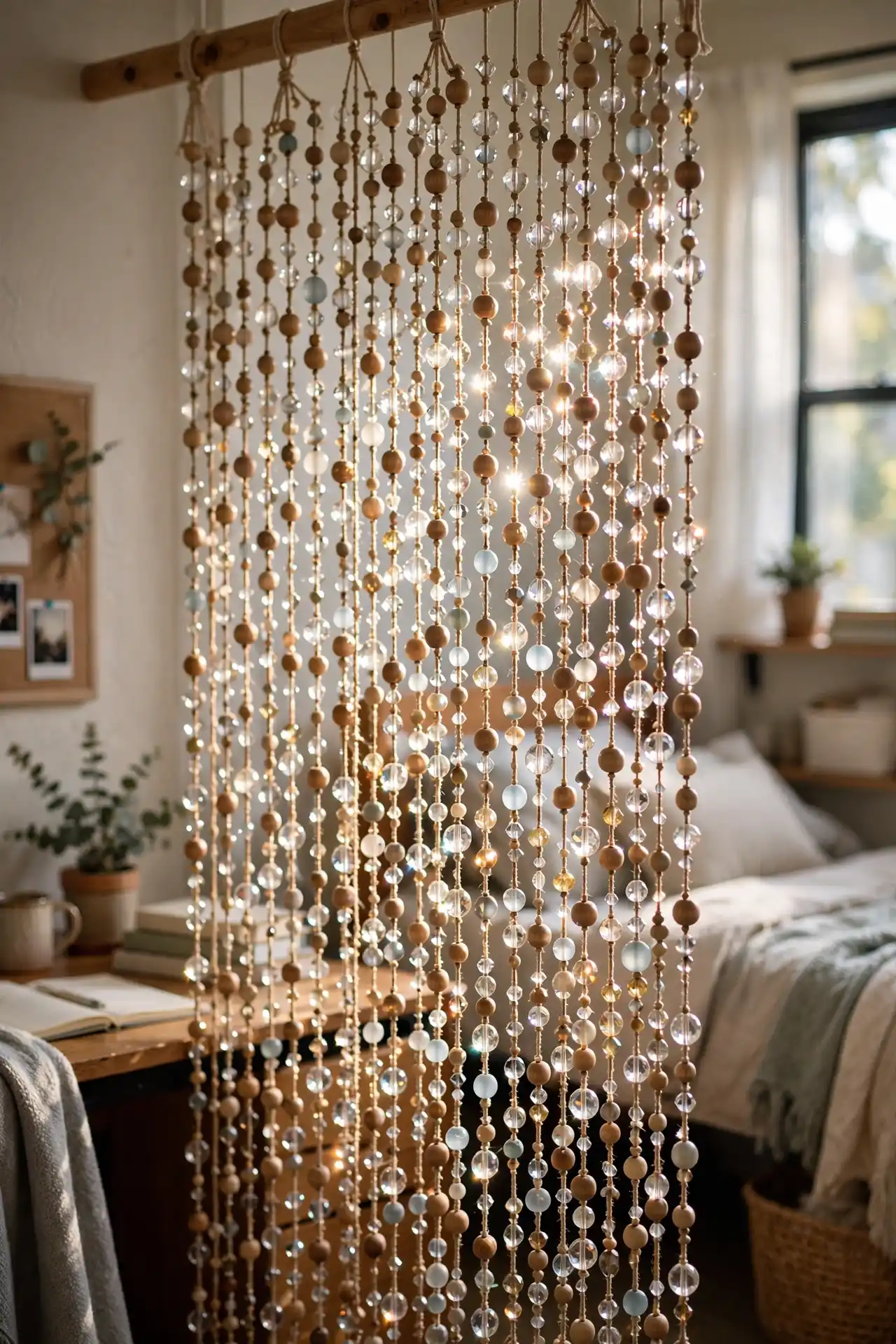
Sharing a room with zero visual separation makes even a spacious dorm feel cramped.
A beaded curtain hung from a tension rod between the two halves gives each side a sense of its own space without blocking light or airflow the way a solid room divider would.
It also doesn’t require any drilling, which matters for anyone worried about move-out deposits.
17. Turn a Plain Cork Board Into a Wax Print Fabric Memo Board
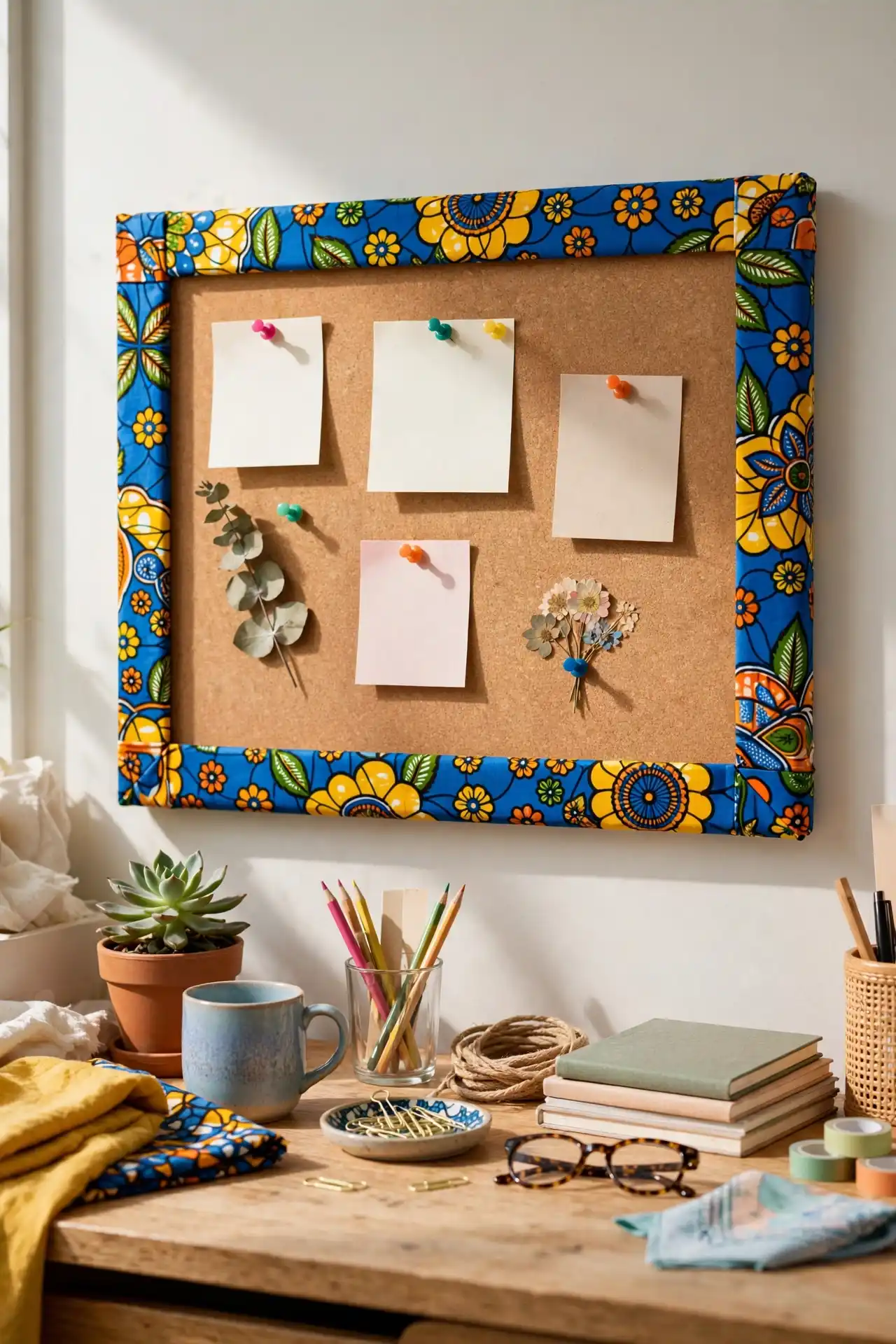
The cork board that came with your desk setup usually stays that raw tan color the entire year, which sticks out against everything else in the room.
Wrapping it in a scrap piece of wax print fabric changes that instantly, since the fabric pulls the memo board into your room’s actual color story instead of leaving it looking like leftover dorm equipment.
What you need for this one:
- One scrap piece of wax print fabric, slightly larger than the board
- A staple gun or strong fabric tape
- Push pins that match or contrast with the fabric pattern
What you need
18. Stack Books by Black Authors as Both Decor and a Reading List

A stack of books on a nightstand does double duty when the titles are chosen on purpose instead of grabbed at random.
Building your stack around Black authors turns a purely decorative moment into something you’ll actually reach for between classes.
Stack them by height rather than alphabetically, since a slightly uneven stack looks more natural sitting beside a lamp than a perfectly squared one.
A quick comparison of stacking approaches:
| Random Grab | Curated Stack |
|---|---|
| Titles picked without much thought | Books chosen with intention |
| Often mismatched sizes look messy | Height-stacked for a natural look |
| Rarely gets opened again | Doubles as an actual reading list |
Stack by height, largest on bottom.
Choose titles with intention, not at random.
Stacking alphabetically for a stiff look.
Grabbing whatever’s nearby to fill space.
19. Dress Up Command Hook Storage With a Raffia Basket Wall Grid

Command hooks are the backbone of dorm organization since nothing can be drilled into the wall, but bare hooks alone tend to look sparse and utilitarian.
Mounting a small grid of raffia baskets onto those same hooks solves both problems at once, giving you real storage for scarves or accessories while covering up the hooks themselves with texture.
⚠️ Watch Out
Check your dorm’s weight limit per hook before loading a basket, since overfilled baskets can pull hooks off drywall.
20. Give Your Mirror Frame a Cowrie Shell Border Upgrade
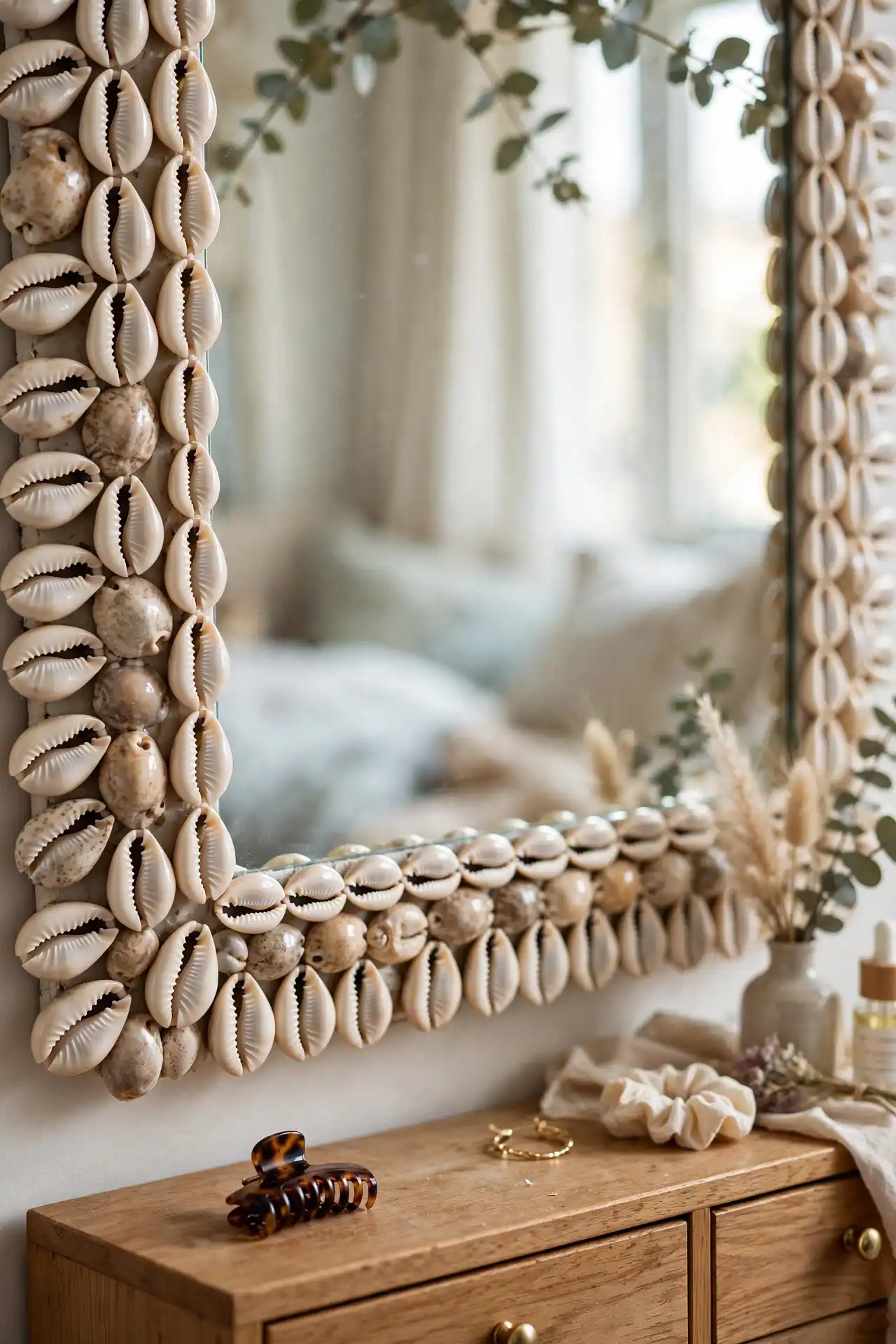
The plastic-framed mirror that comes standard in most dorms rarely matches anything else in the room.
A border of cowrie shells glued directly around the frame’s edge covers that mismatched plastic completely and adds a textured, dimensional detail that catches light differently depending on where you’re standing.
Use a strong craft glue and work in small sections so the shells set before gravity pulls them down.
Plain plastic frame that clashes with the rest of the room.
Fully bordered in cowrie shells, catching light from every angle.
Conclusion
None of these twenty ideas need a huge budget or power tools, just a bit of intention about what actually goes on the walls, the shelves, and the floor.
That’s really the difference between a room that looks temporary and one that feels like yours for the whole year.
Start with one or two moves, maybe the cinder block wall or the closet door vision board, before tackling the rest.
The best HBCU dorm room decor ideas aren’t the ones copied straight off a mood board.
They’re the ones that carry a bit of your own story into a room you’re only borrowing for a couple semesters.
Save this list for move-in week, or for whenever the room starts feeling like it needs a refresh.